Last updated on July 10, 2026
By many accounts, we live in another time of great moral collapse. Look around. Marriage has been redefined.[1] Physician-assisted suicide is on the advance.[2] Over 50% of active Christians admit to viewing pornography frequently.[3] Governmental authorities fail to support the dictates of natural law and public educational institutions tend to actively reject their duty to produce “wise, honorable, and cultivated citizens.”[4] The cultural privilege the church once enjoyed is fading fast. Who can deny it? It is alarming for those who hold to Biblical moral teaching. Yes, this account is simplistic and there are many exceptions and variables, but the simplistic version has a pretty loud megaphone.
People need laws and moral accountability in order to flourish. William Golding depicted what can happen when the ordering authorities disappear. The boys go feral.[5] In our case, the authorities are not missing, but they fail dramatically to function as God intends.[6] Are Americans going feral? Or ask it this way: are they going feral to a greater degree or differently than at other times? Should we romanticize the past as having more spiritual integrity than the present? These are important conversations to have.
Our society and culture are truly changing and I, myself, have made many arguments that the changes are seldom for the better. That being the case, here is the chief question I mean to ask right now: Are Christians responding to the moral shifts in the best ways?
Sometimes it looks like the church is panicking. It is not hard to find shrill politicized sermons that supplant righteousness with good behavior. I will never forget the Easter morning sermon I once heard that began by railing on the Transgender agenda, drawing outraged gasps from the assembly. That is panic from the pulpit. It seems that preaching the resurrection of the body could pull the weight on its own. One of my former seminary professors used to say, “there is no panic in heaven.” I think that is very wise. So, unless we know something that God doesn’t, we should probably calm down. If God is not panicking, then why are we? May it be on earth as it is in heaven. We don’t have to pretend that life is only roses and rainbows — but a lot of Christians are sweating as if God is an absentee landlord. Panic on the Body of Christ smells like unbelief.
Now, a word of clarification, because this is easily misunderstood. When I say, “don’t panic,” I don’t mean we should become complacent or passive. The problems are real. The decay of our civilization harms real human beings and love requires that we strive for the well-being of our neighbor in any way we can. That means faithful preaching, catechizing our children, caring for the poor, and engaging the public square with serene conviction.
Let’s walk in peace, not panic. With God’s help, even if our culture collapses around us, we can find peace in knowing that God is still in control. Consider the worst case. Someday maybe someone will burn down my house and beat me with rods for standing up for the truth. But what of it? God is not worried. So why should we be? That is not bravado. It is faith — and it has been lived before.[7]
Saint Perpetua of Carthage
A final word of encouragement from church history. If we are tempted to chalk this glowing oratory up to hagiographic embellishment, recall the account of the proto-martyr Stephen and his blissful countenance at his demise. This story is not so unimaginable.
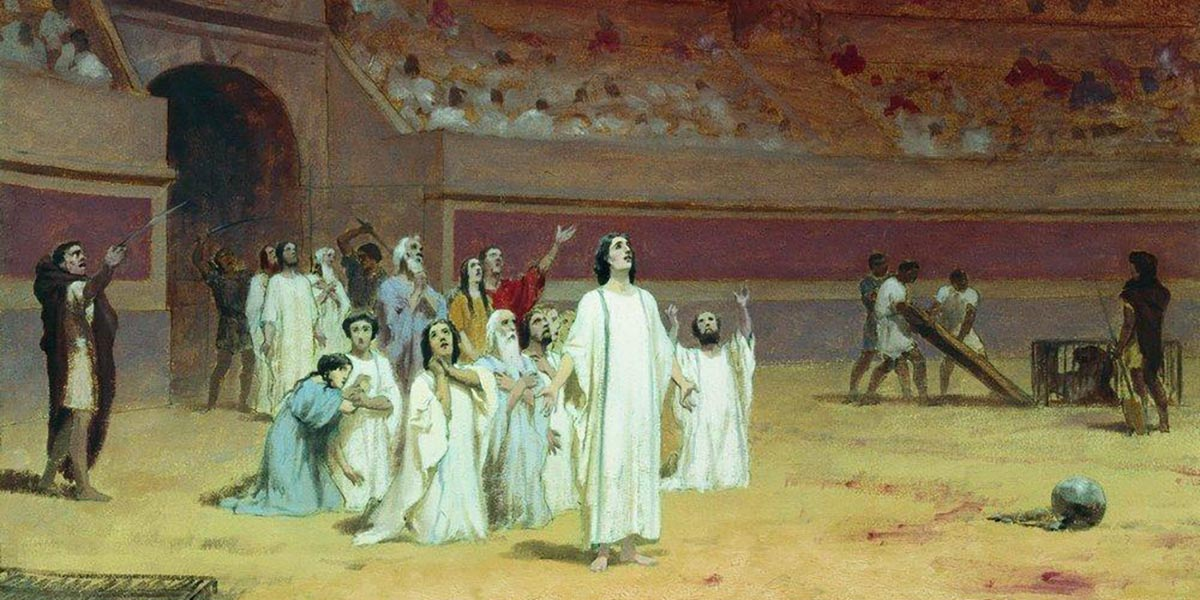
In Carthage in the year 202, a young Christian woman named Perpetua was martyred. She was not a theologian or a bishop. She was a young mother who had every earthly reason to panic — and didn’t. The account of her death has been preserved for eighteen centuries because what witnesses saw that day was so striking they couldn’t look away. She is a model for all of us.
Here is how the ancient record describes her end:
“The day of their victory dawned, and they marched from the prison to the amphitheater joyfully as though they were going to heaven, with calm faces, trembling, if at all, with joy rather than fear. Perpetua went along with shining countenance and calm step, as the beloved of God.”
Shining countenance. Calm step. Trembling with joy rather than fear. Perpetua had not drummed herself into courage at the last moment. That was no performance. No, as the apostle instructs, she had armed herself with the same way of thinking as our Christ who suffered in the flesh (1 Peter 4:1). In baptism[8], Perpetua had already been crucified and raised with Christ. In that light, she could see her martyrdom as a testimony to the life of God within her and the preamble to her own glorious resurrection from the dead.
So let’s show the people of our congregations how to walk into the lion’s den joyfully, to stand before the gladiators like we’re going to heaven — with a shining face and a calm step, because we are God’s beloved. Perpetua and her company were singing as they were led to the deaths, no, their births. Our own hymnody is filled with suitable reminders of God’s promises that His Church shall storm the gates of hell. Let’s sing them now.
Built on the Rock the Church shall stand / Even when steeples are falling.[9]
Though with scornful wonder / The world sees her oppressed,
By schisms rent asunder / by heresies distressed,
Yet saints their watch are keeping; Their cry goes up, “How Long?”
And soon the night of weeping / Shall be the morn of song.[10]
Hard times are coming, ravaged by our prowling enemy the devil. Don’t act surprised when they do. The question is not whether we will face these moments. The question is whether we will face them like Perpetua — or like unanchored souls who forgot that Jesus Christ is Lord.
[1] Traditionally marriage was defined as a life-long, exclusive, and comprehensive union of one man and one woman with an openness to children. Today, data supports the claim that most of those criteria are questioned, whereas the emotional bond is seen as paramount. Another post will elaborate.
[2] Currently legal in 13 states and the District of Columbia with 16 others actively considering it.
[3] Barna: https://www.barna.com/trends/over-half-of-practicing-christians-admit-they-use-pornography/
[4] Martin Luther wrote this in his 1524 open letter, “To the Councilmen of All Cities in Germany That They Establish and Maintain Christian Schools”.
[5] Lord of the Flies
[6] Examine Martin Luther’s explanation of the doctrine of the Two Kingdoms, or the two-fold reign of God.
[7] I do not claim to personally be an exemplar of this kind of faith. It is the kind of faith which I pray for God to give me.
[8] Baptism, “which now saves us” according to 1 Peter 3:2.
[9] Nikolai Grundtvig, Built on the Rock the Church Shall Stand, Lutheran Service Book 645.
[10] Samuel John Stone, The Church’s One Foundation, Lutheran Service Book 644.
© 2026, Scott Stiegemeyer. All rights reserved.
